EMT Practice Test

1. Question Content...


Question List

Question1: What are three recommended prerequisites before upgrading virtual machine hardware? (Choose three.)

Question2: How does vSphere High Availability calculate the memory slot size of a virtual machine?


Question3: An administrator observes the following symptoms for a virtual machine:
CPU usage is consistently above 90%

CPU ready value is consistently above 20%.

Application performance is impacted.

Which two actions should the administrator take to improve the performance of this virtual machine?
(Choose two.)

Question4: When upgrading vCenter Server, an administrator notices that the upgrade fails at the vCenter Single Sign-On installation.
What must be done to allow the upgrade to complete?

Question5: Refer to the Exhibit.

An administrator is changing the settings on a vSphere Distributed Switch (vDS). During this process, the ESXi Management IP address is set to an address which can no longer communicate with the vCenter Server.
What is the most likely outcome of this action?

Question6: Which two statements are true regarding iSCSI adapters? (Choose two.)

Question7: Deletion of an NFS datastore generates the following error:
Sysinfo error on operation returned the following status: Busy
Which step can be performed that will allow the deletion to complete successfully?

Question8: Which three are requirements for configuring Storage I/O Control (SIOC)? (Choose three.)

Question9: What is the name of the High Availability agent log?
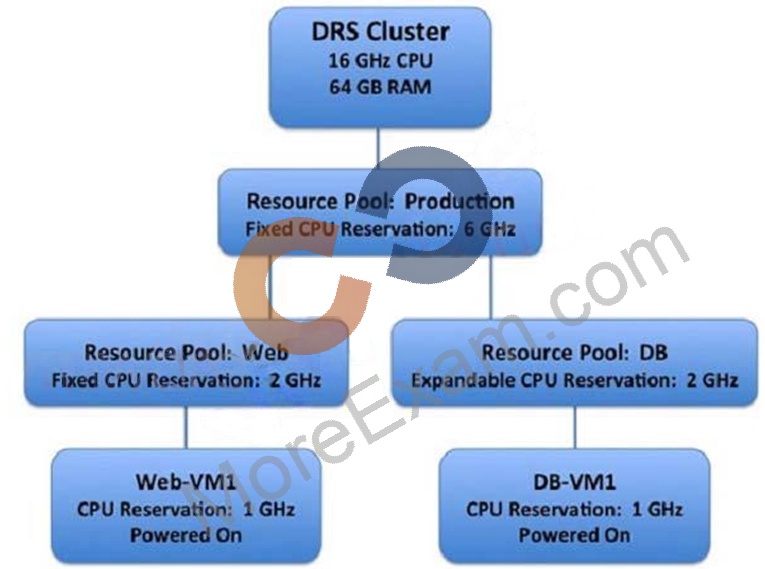
Question10: Refer to the Exhibit.

A vSphere 6.x DRS cluster is configured as shown in the Exhibit.
Based on the exhibit, which statement is true?

Question11: Which two reasons would prevent Storage Distributed Resource Scheduler (SDRS) from operating on a datastore? (Choose two.)

Question12: Refer to the Exhibit.

An administrator has configured Distributed Resource Scheduler (DRS) groups and Affinity Rules as shown in the Exhibit.
Based on the exhibit, which two statements are true? (Choose two.)

Question13: Refer to the Exhibit.

An administrator is troubleshooting a CPU performance related problem for the SlowVM virtual machine.
Which three actions should the administrator take to improve CPU performance for SlowVM? (Choose three.)

Question14: Refer to the Exhibit.

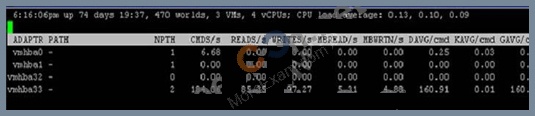
An administrator is using the esxtop command to troubleshoot storage performance issues on a virtual machine. The esxtop capture is shown in the Exhibit.
Based on the exhibit, which two statements are true? (Choose two.)

Question15: Refer to the Exhibit.

An administrator receives vRealize Operations alerts for the Health of the virtual machine PVMAPP_0 as shown in Exhibit 1:
The administrator clicks on the Analysis pane, as shown in Exhibit 2:

Based on the exhibits, what action would correctly address the performance problems observed?

Question16: An administrator is experiencing network connectivity issues between virtual machines. The virtual machines and hosts are configured as follows:
VM1 is running on Host1

VM2 is running on Host2

Both Host1 and Host2 are attached to the vSphere Distributed Switch dvSwitch1

Both Host1 and Host2 are using vmnic0 and vmnic1 on dvSwitch1

Both virtual machines are using the default portgroup for network traffic

What are three settings the administrator should investigate while troubleshooting the connectivity issue?
(Choose three.)

Question17: Where is a Virtual SAN Fault Domain configured?

Question18: Which secondary Private VLAN (PVLAN) type can communicate and send packets to an Isolated PVLAN?

Question19: After configuring a Virtual SAN cluster, an administrator using the vSphere Web Client notices that the Virtual SAN datastore is smaller than expected. The cluster contains:
Three ESXi hosts

Each host has one 10GB SDD

Each host has one 100GB HDD

Why would the Virtual SAN datastore show as 100GB instead of 300GB?

Question20: An administrator is configuring the clock tolerance for the Single Sign-On token configuration policy and wants to define the time skew tolerance between a client and the domain controller clock.
Which time measurement is used for the value?

Question21: An administrator has decided to create 10 ESXi 6.x hosts via Auto Deploy for a new Test/Dev cluster. The hosts are configured to obtain their networking configuration via DHCP.
Which Direct Console User Interface option should the administrator use to renew the DHCP lease for the hosts?

Question22: An administrator notices that there is an all paths down (APD) event occurring for the software FCoE storage.
What is a likely cause?

Question23: An administrator observes that virtual machine storage activity on an ESXi 6.x host is negatively affecting virtual machine storage activity on another host that is accessing the same VMFS Datastore.
Which action would mitigate the issue?

Question24: An administrator wants to monitor virtual machines on a host and send notifications when memory usage reaches 80%.
What should the administrator create in vCenter Server to accomplish this?

Question25: Which file determines the location of the installation script during a scripted upgrade?

Question26: Which two statements are true regarding Virtual SAN Fault Domains? (Choose two.)

Question27: Refer to the Exhibit.
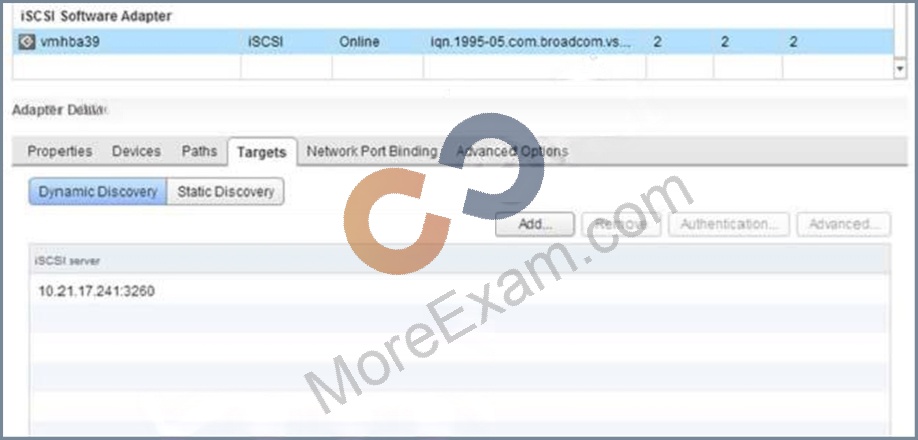
Which tab shows the Hardware Acceleration support status?

Question28: An administrator is using Auto Deploy to create several ESXi 6.x hosts that will be connected to a vSphere Distributed Switch. After the hosts are deployed, the administrator notices that LACP packets are not being sent between them.
Which statement best describes why this issue is occurring?

Question29: What are two ways to view the DNS settings for an ESXi 6.x host? (Choose two.)

Question30: An administrator is unable to patch an ESXi 6.x host using VMware Update Manager.
What is an alternative option for patching a host?

Question31: An administrator wants to configure a High Availability cluster to allow virtual machines a 10 minute window to shut down in the event of a Host Isolation incident.
What two configuration settings would satisfy this requirement? (Choose two.)

Question32: Refer to the Exhibit.

A Storage Policy for a Virtual SAN is set to the default policy, as shown in the Exhibit.
Which change would reduce the storage consumption by one third?

Question33: In a vSphere High Availability cluster, what is the VM Monitoring I/O stats interval default value?

Question34: Which two are valid compliance results that indicate the need to apply a Host Profile? (Choose two.)

Question35: An administrator enables High Availability (HA) on a Virtual SAN cluster.
There are four vmkernel port groups with the following IP addresses assigned:
Management: 192.168.12.10

vMotion: 192.168.13.10

Virtual SAN: 192.168.14.10

Fault TolerancE. 192.168.15.10

Which IP address will HA use for traffic?

Question36: When attempting to place a datastore in Maintenance Mode, the task remains at 1%.
What are two potential causes for this? (Choose two.)

Question37: An administrator attempts to place a Storage DRS enabled Datastore into Maintenance Mode. The task never completes, and the Entering Maintenance Mode status remains at 1%.
Which two actions should the administrator take to resolve this problem? (Choose two.)

Question38: Which three options are available for replacing vCenter Server Security Certificates? (Choose three.)

Question39: An administrator is deploying ESXi 6.x hosts using Auto Deploy and wants the image profile to be available, even after closing and opening a new PowerCLI window.
Which command can be used to ensure that image profiles are preserved across PowerCLI sessions?

Question40: An administrator is observing slow performance of the vCenter Inventory Service and observes the entries from the wrapper.log file:
Exception in thread "tomcat-exec-2" java.lang.OutOfMemoryError: Java heap spaceException in thread
"http-bio-0.0.0.0-10443-Acceptor-0" java.lang.OutOfMemoryError: Java heap space What should the administrator do to resolve the problem?

Question41: Which three logs can be reviewed to troubleshoot a vCenter Server upgrade failure? (Choose three.)

Question42: Which three statements are correct regarding Fibre Channel over Ethernet (FCOE)? (Choose three.)

Question43: An administrator is troubleshooting a virtual machine performance issue using vRealize Operations.
Which two badges would help to identify possible resource contention concerns? (Choose two.)

Question44: Users are reporting CPU related performance problems on the virtual machine Email-Prod throughout the day.
The resource settings for the VM and the ESXi host the VM is running on are shown below:
VM:
Email-Prod

vCPUs: 4

Memory: 96GB

ESXi host:
CPU: 2 x 8 Core Processors

Memory: 128GB

NUMA architecturE. 2 Nodes

Which two options would alleviate the observed performance problem for Email-Prod? (Choose two.)

Question45: An administrator is having a problem configuring Storage I/O Control on a Datastore.
Which two conditions could explain the issue? (Choose two.)

Question46: An administrator created a six node Virtual SAN cluster, created a fault domain, and moved three of the six nodes into that domain.
A node that is a member of the fault domain fails.
What is the expected result?

Question47: A virtual machine is exhibiting these symptoms:
Memory usage is constantly high (94% or greater) or constantly low (24% or less).

Free memory is consistently 6% or less and swapping frequently occurs

Which three solutions could correct this problem? (Choose three.)

Question48: Which two groups of settings should be reviewed when attempting to increase the security of virtual machines (VMs)? (Choose two.)

Question49: Refer to the Exhibit.

An administrator is reviewing a vSphere Distributed Resource Scheduler (DRS) enabled Cluster and observes unexpected behavior as shown in the Exhibit.
What are three potential causes of the cluster imbalance? (Choose three.)

Question50: An administrator is troubleshooting a CPU issue for a virtual machine. The following is seen in esxtop:
CPU0 is at 100% usage

The remaining logical CPUs are close to 0%

%RDY value is consistently above 10%

What is likely the cause of the CPU issue?

Question51: An administrator has been instructed to secure existing virtual machines in vCenter Server.
Which two actions should the administrator take to secure these virtual machines? (Choose two.)

Question52: Which two considerations should an administrator keep in mind when booting from Software Fiber Channel over Ethernet (FCoE)? (Choose two.)

Question53: Which three troubleshooting actions should an administrator take to address slow performance when deploying a virtual machine template? (Choose three.)

Question54: An administrator is troubleshooting a CPU performance issue for a virtual machine.
Which three esxtop counters may demonstrate CPU contention? (Choose three.)

Question55: An administrator has upgraded a Distributed vCenter Server environment from 5.5 to 6.0.
What is the next step that should be taken?

Question56: Which two features are available for virtual machines configured with DirectPath I/O? (Choose two.)

Question57: An administrator needs to recover disk space on a previously-used thin provisioned virtual disk. The volumes where the administrator needs to recover the disk blocks are on VAAI-compliant storage arrays.
Which two actions should the administrator take accomplish this task? (Choose two.)

Question58: An administrator needs to create an Integrated Windows Authentication (IWA) Identity Source on a newly deployed vCenter Server Appliance (VCSA).
Which two actions will accomplish this? (Choose two.)

Question59: An administrator is attempting to enable Legacy Fault Tolerance (FT) on a virtual machine and observes the following in the vSphere Web Client:
Fault Tolerance has not been licensed on host <hostname>.
What is the minimum licensed edition that supports this configuration?

Question60: Refer to the Exhibit.

Examine the esxtop command output shown in the Exhibit.
Which option would improve application performance for the SlowVM virtual machine?

Question61: An administrator creates a Private VLAN with a Primary VLAN ID of 2. The administrator than creates three Private VLANs as follows:
Marketing

PVLAN ID. 4

PVLAN Type. Isolated

Accounting

PVLAN ID. 5

PVLAN Type. Community

Secretary

PVLAN ID. 17

PVLAN Type. Isolated

Users in the Accounting PVLAN are reporting problems communicating with servers in the Marketing PVLAN.
Which two actions could the administrator take to resolve this problem? (Choose two.)

Question62: When attempting to log in with the vSphere Web Client, users have reported the error:
Incorrect Username/Password
The administrator has configured the Platform Services Controller Identity Source as:
Type. Active Directory as an LDAP Server

Domain: vmware.com

Alias: VMWARE

Default Domain: Yes

Which two statements would explain why users cannot login to the vSphere Web Client? (Choose two.)

Question63: An administrator has a virtual machine configured with the following settings:
ESXi version: 5.1

CPU: vCPUs 6

Memory: 48GB

Hardware version: 7

VMware Tools: Installed

Which two actions must the administrator take in order to utilize vNUMA? (Choose two.)

Question64: Which two tasks does the Pluggable Storage Architecture (PSA) perform? (Choose two.)

Question65: A failed upgrade from vCenter Server version 5.x to version 6.0 produces the following error:
[00800 error 'Default'] Database version id '600' is incompatible with this release of VirtualCenter.
What is the cause of the upgrade failure?

Question66: Refer to the Exhibit.

The Prod-DB virtual machine has a VM Override as shown in the Exhibit.
What step, if taken, would require all virtual machines in the cluster to migrate automatically?

Question67: A device's vStorage API for Array Integration (VAAI) support status command line output shows:
naa.500253825002a865 VAAI Plugin Name: ATS Status: unsupported Clone Status: unsupported Zero Status: supported Delete Status: unsupported What is the corresponding VAAI support status in the vSphere Web Client?

Question68: Which Advanced Setting should be created for the vCenter Server to change the expiration policy of the vpxuser password?

Question69: Which two scenarios could cause Storage DRS to be disabled on a Virtual Disk (VMDK)? (Choose two.)

Question70: A vSphere 6 High Availability cluster has been configured with default settings. Four virtual machines in the cluster have been configured with these priorities:
Prod-DB. High

Prod-Email: High

Prod-VC. Medium

Dev-VDI: Low

How many VM Overrides would need to be defined at the cluster level to meet the restart priorities?

Question71: An administrator tries to capture network traffic for a virtual machine, but cannot see the expected traffic in the packet capture tool.
Which step can resolve the problem?

Question72: An administrator wants to prevent a priority virtual machine that resides in a vSphere DRS cluster from migrating to other hosts in the cluster.
What configuration step will accomplish this without affecting other virtual machines?

Question73: A task fails while creating a VMFS5 datastore on a disk with these characteristics:
Was previously used by a Linux server

Was not erased

Is visible with the vSphere Web Client

Which action can be performed to resolve the issue?

Question74: An administrator is writing a kickstart script to upgrade an ESXi 6.x host.
In which three locations can the script reside? (Choose three.)

Question75: A user notifies an administrator that Content Libraries are not visible.
What is a possible solution?

Question76: What is the minimum Virtual Hardware version required for vFlash Read Cache?

Question77: An administrator wants to select a Host Power Management Policy for an ESXi 6.x host that will disable most hardware power management features.
Which Host Power Management Policy should be selected to meet this requirement?

Question78: An administrator is upgrading a vCenter Server Appliance and wants to ensure that all the prerequisites are met.
What action must be taken before upgrading the vCenter Server Appliance?

Question79: An administrator is assigning a user the Content Library administrator role. The user will only be creating the library for a single vCenter Server.
What is the lowest level of the permission heirarchy that this role can be granted to the user and still allow them to create a Content Library?

Question80: Which three connection types are supported between a remote site and vCloud Air? (Choose three.)

Question81: Refer to the Exhibit.

An administrator reviews the Health of a virtual machine, as shown in the Exhibit.
Based on the exhibit, which three metrics can be used to determine the virtual machine's Workload characteristics? (Choose three.)

Question82: What three supported methods can be used to upgrade a host from ESXi 5.x to ESXi 6.x? (Choose three.)

Question83: An administrator is building a large virtual machine that will require as many vCPUs as the host can support. An ESXi 6.x host has these specifications:
Six 32-core Intel Xeon Processors

256 GB of Memory

512 GB Local disk space using VMFS5

What is the maximum number of virtual CPUs that the virtual machine can be allocated?

Question84: Refer to the Exhibit.

What will be the result of selecting the highlighted device?

Question85: An administrator is attempting to enable Fault Tolerance on a virtual machine with 4 vCPUs and observes the following in the vSphere Web Client:
Fault Tolerance has not been licensed on host <hostname>.
What is the minimum licensed edition that supports this configuration?

Question86: An administrator is troubleshooting network communications between the vCenter Server and the ESXi 6.x host.
Which log shows the interaction events between these components?

Question87: Refer to the Exhibit.

An administrator is configuring a storage device as shown in the Exhibit.
What is the expected effect on the stated device after running the command?

Question88: Which two features are deprecated in Network I/O Control 3 (NIOC3)? (Choose two.)

Question89: An administrator wants to reduce the memory overhead for a 3D graphics enabled virtual machine (VM).
What advanced feature can be added to the VM configuration file to reduce memory overhead?

Question90: Which statement is true for the Path Selection Plug-In VMW_PSP_MRU?

Question91: Which two advanced features should be disabled for virtual machines that are only hosted on a vSphere system? (Choose two.)

Question92: An administrator plans to use VMware Converter Standalone to convert a virtual machine to a vSphere environment. The source virtual machine has these properties:
Running Windows 2008 R2

Contains one NTFS formatted volume

During conversion, how many virtual disks can the administrator add to the destination virtual machine?

Question93: To reduce the attack vectors for a virtual machine, which two settings should an administrator set to false?
(Choose two.)

Question94: Which two supported tools can be used to upgrade virtual machine hardware? (Choose two.)

Question95: Which two are valid Identity Sources when configuring vCenter Single Sign-On? (Choose two.)

Question96: Refer to the Exhibit.

An administrator receives the error message shown in the Exhibit.
Which two actions can be taken to clear the warning? (Choose two.)

Question97: When troubleshooting a performance related issue, an administrator sees the following warning message on an ESXi Console:
Significant imbalance between NUMA nodes detected. Performance may be impacted.
Which action should the administrator take to correct this problem?

Question98: What are two reasons why a local flash device would be unavailable for use with Virtual SAN? (Choose two.)

Question99: An administrator tries to run esxtop to troubleshoot CPU performance issues, but no output is displayed.
How can the issue be resolved?

Question100: What are two likely causes for a DRS cluster to become unbalanced? (Choose two.)

Question101: An administrator is troubleshooting a performance problem with a virtual machine (VM). The VM and ESXi host configuration is as follows:
The application which runs within the virtual machine is highly sensitive to memory latency, but has low

processor utilization.
The virtual machine has 6 vCPUs.

The ESXi host CPU topology has 2 Physical CPU Sockets, each with 8 Logical CPUs.

The ESXi host CPU has Hyper Threading enabled.

The administrator would like to improve CPU performance for this VM. Other VMs on the host have no performance issues. Which action should the administrator take to resolve the issue?

Question102: Which two identification sources can a vSphere Auto Deploy rule use to identify target hosts? (Choose two.)

Question103: Which two options are available in the Virtual Machine Component Protection (VMCP) setting Response for Datastore with All Paths Down (APD)? (Choose two.)

Question104: An administrator is performing a silent automatic update of VMware Tools on a Windows virtual machine.
What syntax needs to be entered into the Advanced Options box?

Question105: When attempting to remove a host from a vSphere Distributed Switch (vDS), an administrator observes the error message:
The resource '16' is in use
What are two reasons why this error would be displayed? (Choose two.)

Question106: Which password meets ESXi 6.x host password requirements?

Question107: What are two use cases for Fibre Channel Zoning in a vSphere environment? (Choose two.)

Question108: Refer to the Exhibit.

An administrator wishes to provide Load Balanced I/O for the device shown in the Exhibit.
To meet this requirement, which setting should be changed?

Question109: An administrator is troubleshooting a virtual machine that has unexpectedly powered off.
Which two logs should be used to troubleshoot the issue? (Choose two.)

Question110: An administrator runs the command esxcli storage core device list and sees the following output:
mpx.vmhba1:C0:T0:L0 Display Name: RAID 5 (mpx.vmhba1:C0:T0:L0) Has Settable Display Name: false SizE. 40960 Device Type: Direct-Access Multipath Plugin: NMP Devfs Path: /vmfs/devices/disks/ mpx.vmhba1:C0:T0:L0 Status: off Is Local: true What can be determined by this output?

Question111: An administrator is unable to upgrade a vCenter Server Appliance from version 5.1 Update 2 to version 6.0.
What is a likely reason for this?

Question112: An administrator is upgrading an ESXi host from 5.5 to 6.0 and runs the following command:
esxcli software vib list --rebooting-image
What does this command show?

Question113: Refer to the Exhibit.

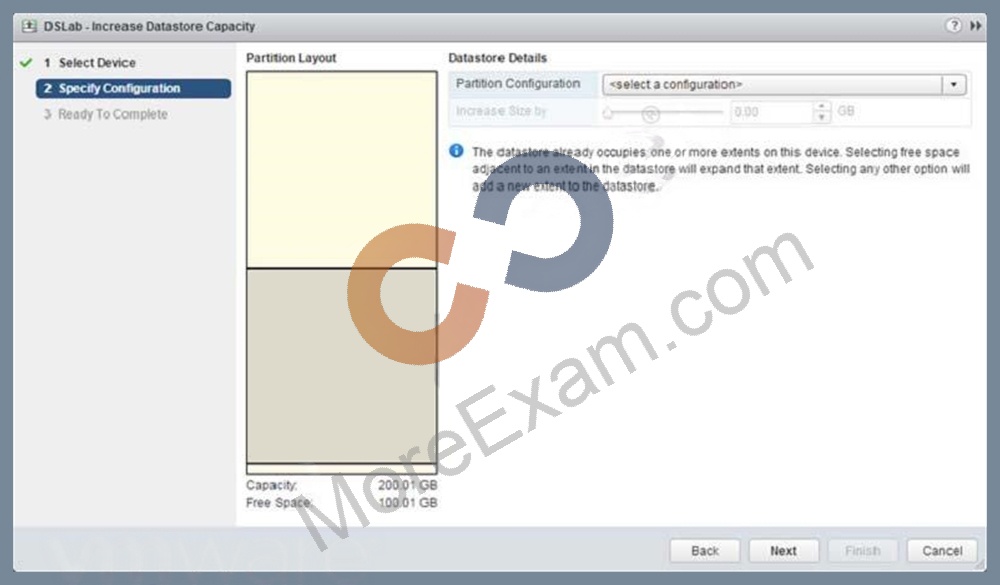
An administrator wants to increase the capacity of a VMFS5 datastore; but the Increase Size by slider is not available, as shown in the Exhibit.
How should the administrator resolve this problem?

Question114: Which VMware Single Sign-On component issues Security Assertion Markup Language (SAML) tokens?

Question115: Which two statements are true regarding VMFS3 volumes in ESXi 6.x? (Choose two.)

Question116: The command esxcli network vm list displays four virtual machines connected to the Production vSwitch.
Within the vSphere Web Client, five virtual machines are seen.
What explains this behavior?

Question117: An administrator suspects that the MTU value for a vSphere Standard Switch is misconfigured.
Which two commands can determine the value? (Choose two.)

Question118: An administrator subscribes to the vCloud Air Disaster Recovery service.
Which replicated objects can be directly monitored and managed?

Question119: An administrator has migrated a vCenter Server Appliance from version 5.5 to version 6.x. During the migration, the administrator selected DHCP for the appliance and obtained a hostname from the DHCP server. The administrator adjusts the hostname after the migration and uses a static IP and hostname.
What should the administrator do immediately after this change to prevent service failures?

Question120: What are two limitations of Link Aggregation Control Protocol (LACP) on a vSphere Distributed Switch?
(Choose two.)

Question121: Which two scenarios would cause a Fault Tolerance-enabled virtual machine to fail to power the Secondary virtual machine? (Choose two.)

Question122: An administrator notices that one virtual machine is in an orphaned state.
What are two reasons that a virtual machine can appear as orphaned? (Choose two.)

Question123: An administrator is configuring virtual machines to use Worldwide Port Names (WWPNs) to access the storage.
Which two conditions are required? (Choose two.)

Question124: An administrator is creating a new Content Library. It will subscribe to another remote Content Library without authentication enabled.
What information from the published library will they need in order to complete the subscription?

Question125: Refer to the Exhibit.

An administrator is adding an Active Directory over LDAP Identity Source for vCenter Single Sign-On, as indicated in the Exhibit.
What is the correct value to configure for the Domain alias?

Question126: Which two settings are required for Virtual Machine Component Protection (VMCP) to protect from All Paths Down (APD) and Permanent Device Loss (PDL)? (Choose two.)

Question127: Which group in the vsphere.local domain will have administrator privileges for the VMware Certificate Authority (VMCA)?

Question128: An administrator wants to upgrade to vCenter Server 6.x.
The vCenter Server:
Is hosted on a virtual machine server running Microsoft Windows Server 2008 R2, with 8 vCPUs and

16GB RAM.
Will have an embedded Platform Services Controller.

Hosts a Large Environment with 1,000 ESXi hosts and 10,000 Virtual Machines.

Why does the vCenter Server not meet the minimum requirements?

Question129: What is the command to list multipathing modules on an ESXi 6.x host?

Question130: An administrator notices that a Windows virtual machine is using 95% CPU in Task Manager.
Which two actions should be taken to resolve this issue? (Choose two.)

Question131: What is the name of the command line utility that checks for VMFS5 metadata corruption?

Question132: Which two statements are true regarding Storage Multipathing Plug-Ins? (Choose two.)

Question133: Refer to the Exhibit.

An administrator recently created a Virtual SAN but no Storage Policies were defined. A few virtual machines were deployed to this cluster. The administrator analyzes the default Virtual SAN policy as shown in the Exhibit.
Based on the exhibit, which two statements are true? (Choose two.)

Question134: Which Platform Service Controller Password Policy determines the number of days a password can exist before the user must change it?

Question135: Which two statements are correct regarding vSphere certificates? (Choose two.)

Question136: An administrator has recently audited the environment and found numerous virtual machines with sensitive data written to the configuration files.
To prevent this in the future, which advanced parameter should be applied to the virtual machines?

Question137: When a Content Library is deleted, what happens to the files contained on the backing storage?

Question138: An administrator needs to migrate a legacy physical application server to a virtual machine within a vSphere 6 cluster. As part of the conversion, the administrator must reduce the size of the virtual disks.
What action should the administrator take to create a virtual machine with smaller virtual disks than the original physical server?

Question139: An administrator wants to set a non-default isolation address of 192.168.1.2 for High Availability.
Which advanced setting would accomplish this task?

Question140: What are three reasons why a virtual machine might fail to power on? (Choose three.)

Question141: Which three traffic types can be configured for dedicated VMkernel adapters? (Choose three.)

Question142: An administrator notices that 8 out of 10 virtual machines have memory ballooning and swapping.
However, virtual machine 9 is not ballooning or swapping and virtual machine 10 is not ballooning but is swapping.
Which two statements explain the behavior of virtual machine 9 and virtual machine 10? (Choose two.)

Question143: Which two statements regarding Distributed Resource Scheduler (DRS) affinity rules are true? (Choose two.)

Question144: A vSphere Web Client task fails while creating a VMFS datastore on a disk with these characteristics:
The disk was formatted with a Master Boot Record (MBR) partition table

The disk was not erased

The disk is visible in the vSphere Web Client

What action needs to be performed to resolve the issue?

Question145: Attempting to update an ESXi 6.x host using the following command:
esxcli software vib update -d update.zip
Generates the following error:
Could not download from depot at /tmp/index.xml, skipping (('/tmp/index.xml', '', "[Errno 4] IOError:
<urlopen error [Errno 2] No such file or directory: '/tmp/index.xml'>")) url = /tmp/index.xml What action should be taken to correct the problem?

Question146: An administrator is upgrading an ESXi 5.5 host to ESXi 6.x and gets the following error:
MEMORY_SIZE
What does this indicate?

Question147: An administrator uses the df -h command and notices that an NFS datastore is reporting a capacity of 0 Bytes.
What condition would cause this to occur?

Question148: Which two solutions require Physical Mode Raw Device Mapping (RDM)? (Choose two.)

Question149: An administrator would like to use a passphrase for their ESXi 6.x hosts which has these characteristics:
Minimum of 21 characters

Minimum of 2 words

Which advanced options must be set to allow this passphrase configuration to be used?

Question150: During a vCenter Server upgrade, an ESXi 6.x host in a High Availability (HA) cluster fails.
Which statement is true?

Question151: An administrator is concerned about possible vCPU over-commitment for an ESXi 6.x host.
Which two Performance Counters should be reviewed in the vSphere Web Client Performance Charts to confirm if there is contention on the host? (Choose two.)